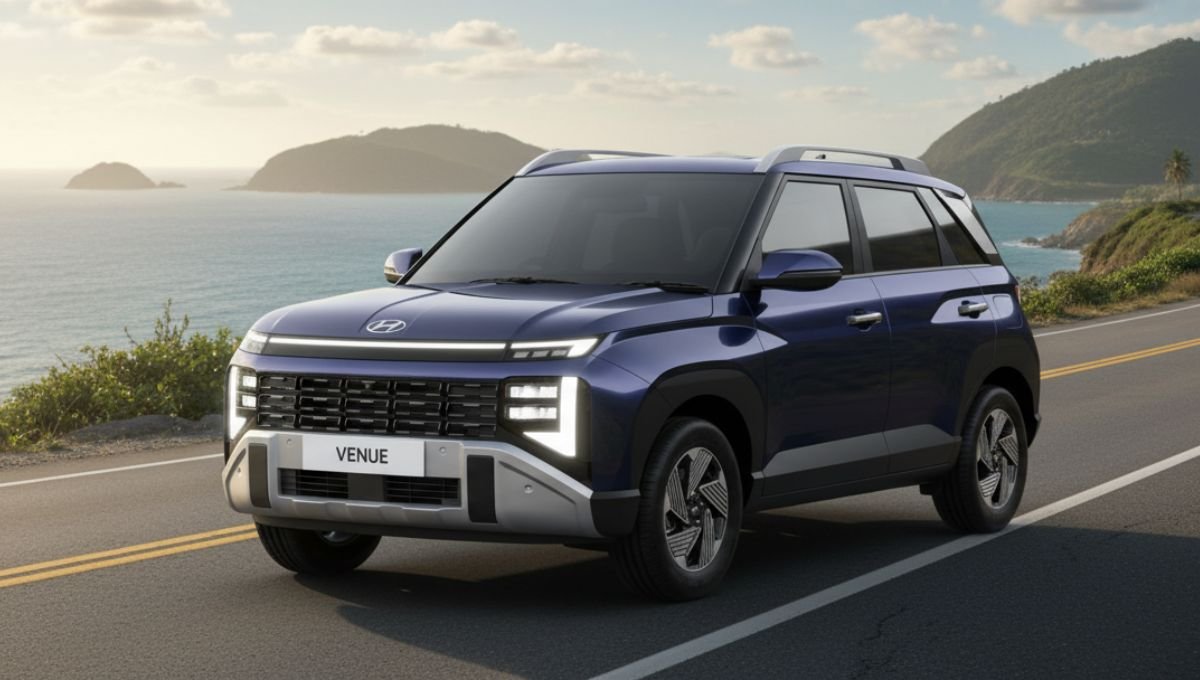
The compact SUV scene in India is buzzing more than ever, and Hyundai’s just thrown the Hyundai Venue 2025 into the mix with a fun vibe: more is more. It hit the roads in late 2025, and while it’s not a total overhaul, this smart update pulls in fancy touches from the Creta to feel way more upscale. Starting at just ₹7.94 lakh and going up to ₹15.69 lakh (ex-showroom), it finally brings a diesel-automatic option.
Hyundai Venue 2025 Review: Design That Turns Heads
The 2025 Venue has grown slightly to 3,995mm, with a longer 2,500mm wheelbase, yet still stays under the 4-meter limit for lower taxes. It now sits more confidently on the road, helped by sleek parametric LED headlights and a dark chrome grille that give it a mini-Creta vibe. The front bumper looks chunkier with upright fog lamps and silver skid plates for a mild adventure look.
Along the sides, the wider wheel arches, black cladding, and 16-inch diamond-cut alloys add presence, while the N Line amps it up with red calipers, a two-tone roof, and stylish twin exhaust-style elements. At the rear, the connected LED taillights with a 3D effect and the bold “Venue” branding make it look more premium. It’s not radical, but it definitely stands out in everyday traffic. Fuel efficiency is impressive too, with petrol delivering up to 20 kmpl and diesel touching 20.99 kmpl in ARAI tests.
New Hyundai Venue First Drive Review
Driving the 2025 Venue around Goa felt instantly natural—salty air, smooth curves, and a car that just fits the mood. The 1.0L turbo-petrol N Line is quick and lively, hitting 0–100 kmph in about 10.5 seconds with smooth highway shifts, though a bit jerky in traffic, while its drive modes and subtle exhaust note add some fun. The new 1.5L diesel auto is even more impressive, delivering strong low-end torque, quiet cabin manners, and real-world mileage of 20–22 kmpl. Ride quality is plush across the board, with the N Line slightly firmer for better control without losing comfort. It may not be the sportiest in the segment, but for India’s unpredictable roads, the Venue feels steady, easy going, and reassuring—like a friend you can count on every day.
More Information : Hyundai Venue 2025
Hyundai Venue 2025 Interior Review
Step inside the 2025 Venue and it instantly feels welcoming, with a stylish terrazzo-patterned dash, bronze accents, and materials that feel genuinely premium. The twin 10.25-inch displays run on Nvidia-powered Bluelink OS, making everything—from maps to menus—quick and lag-free. Daily comforts hit the mark too: wireless CarPlay/Android Auto, an 8-speaker Bose system, cooled front seats, a wireless charger, a chilled glovebox, rear sunshades, and 64-color ambient lighting.
The rear seat now offers better knee room thanks to the longer wheelbase, though thigh support could be better for long trips. With a slightly bigger 350L boot, it handles weekend getaways and everyday runs with ease.
Hyundai Venue Turbo Petrol Review
If you enjoy a little spark in your daily drive, the 1.0L Kappa turbo is a great fit. With 120 PS and 172 Nm, it pulls confidently between 40–80 kmph, making overtakes smooth and stress-free, while the 7-speed DCT feels sharp in Sport—even if it gets a bit jerky in slow traffic. Expect around 16–18 kmpl in the city and up to 19–20 kmpl on the highway, which is solid for a turbo. There’s a slight pause below 1,800 rpm, but once it spools up, the throttle feels eager, and the iMT option keeps things light and easy in manual mode. It’s not built for thrills, but for daily commutes, mall runs, and quick dashes across town, it’s lively, affordable to run, and genuinely fun.
Venue 2025 ADAS Features: Safety That Actually Works
From mid-trims, Hyundai’s Smart Sense Level 2 ADAS steps up like a smart co-pilot. Adaptive cruise chills on highways, lane keep you straight over 60 kmph. Forward collision watch works in town or fast lanes, blind-spot cam shows live views, and rear cross-traffic beeps when backing up.
In Goa tests, it hugged curves steady and warned sharp at 50 kmph – no overreactions. The 360 cam with moving lines? Parking hero in tight spots. Plus basics like 6 airbags everywhere, ESC for slips, hill-start help, fancy tire pressure alerts, and 72% tough steel body. Crash scores from Global NCAP are coming, but it drives solid and safe.
Also Read : Skoda Octavia RS 2025 Review: A Powerful Sedan You’ll Want to Own